ORM: the executable ontology
GND starts from one artifact: a conceptual model of your domain, written in Object-Role Modeling (ORM 2). It is an ontology in the practical sense: the things your application talks about, the facts that relate them, and the rules those facts must or should obey. It is also executable. GND checks agent output against it, generates synthetic data and code from it, and exports it to other engines.
ORM is Terry Halpin's fact-based conceptual modeling method. (It has nothing to do with object-relational mappers.) GND uses it because it suits checking agent output:
- Everything is an elementary fact. There are no attributes, only roles that objects play in fact types. That makes every rule about a combination of facts explicit and checkable.
- Every element reads back as a sentence. A domain expert can confirm "Each Book has exactly one primary genre" without reading YAML.
- Constraints have a modality. Alethic rules (must) decide acceptance; deontic rules (should) produce warnings.
- It is a small, well-studied notation with decades of tooling and literature, so the model is a reviewable artifact rather than a prompt.
From sentences to facts
Suppose an application recommends books. You want to ask: does this output include a book the reader already read? That question needs a rule and facts, and GND keeps both explicit.
| Term | Meaning | BookRec example | In model.orm.yaml |
|---|---|---|---|
| Object type | A kind of thing (entity) or value | User, Book, Genre | object_types |
| Fact type | A relationship with named roles | User rated Book | fact_types |
| Population | The facts being checked | ada rated read |
a population file's facts |
| Constraint | A condition the facts must or should satisfy | Recommended and rated pairs must not overlap | constraints |
| Derivation | A rule defining additional facts | A book is eligible when preferred, unread and allowed | derivation_rule |
| Provenance | Why a rule is present | The requirement sentence that motivated it | provenance.user_quote |
You do not need a database: models and populations are ordinary YAML and JSON files.
Halpin's design procedure is to verbalize example facts first, then group them into
fact types, then add constraints by asking questions about populations. The
gnd-model-from-text skill walks you through exactly that dialogue
(model a domain by dialogue).
The model is an ORM 2 model
Each diagram below uses standard ORM 2 notation. Beside it is the corresponding part of the BookRec model you open in chapter 1.
object_types:
  - {id: user, kind: entity,
     reference: {mode: popular, value_type: user_id}}
  - {id: book, kind: entity,
     reference: {mode: popular, value_type: book_id}}
fact_types:
  - id: user_rated_book
    reading: "{User} rated {Book}"
    roles: [{object_type: user, role_name: user},
            {object_type: book, role_name: book}]
Object types and a fact type. User and Book are entity types (soft rectangles) identified by an id. "User rated Book" is a binary fact type with one role box per participant.
- id: book_has_genre
  reading: "{Book} has primary genre {Genre}"
  constraints:
    - {type: uniqueness, roles: [book],
       modality: alethic}
    - {type: mandatory, role: book,
       modality: alethic}
Uniqueness and mandatory. Genre is a value type (dashed). The bar over the Book role means at most one primary genre; the dot where the line meets Book means at least one. Together: exactly one.
id: unread_only
type: guarded
modality: alethic
antecedent:
  - fact_type: recommendation
    bind: {user: "$u", book: "$b"}
consequent:
  absence:
    fact_type: user_rated_book
    bind: {user: "$u", book: "$b"}
Exclusion. The circled cross says no (user, book) pair is both recommended and rated. BookRec writes the same rule as a guarded constraint, which lets a rule join several facts; a violation names the offending binding, for example {$u: ada, $b: read}.
- id: age_appropriate      # alethic: must
  type: guarded
  modality: alethic
- id: preferred_genre      # deontic: should
  type: guarded
  modality: deontic
Must versus should. The same kind of rule with a different modality. A violated alethic constraint fails the check; a violated deontic constraint produces a warning and the output can still be accepted.
- id: book_is_eligible
  reading: "{Book} is eligible for {User}"
  derivation: derived
  derivation_rule:
    body:   [user_prefers_genre($u, $g),
             book_has_genre($b, $g)]
    negate: [book_is_blocked_for($b, $u),
             user_rated_book($u, $b)]
Derived fact type. The asterisk marks a fact type computed by a rule rather than supplied (shown here in shorthand). Negation is stratified, and an unknown input yields cannot decide, never a guess. GND compares any supplied claims with the derived result (chapter 6).
operations:
  - id: approve_expense
    parameters: [expense, approver]
    preconditions:
      - id: pre_draft    # only a draft
        require: [expense_has_status($expense, "draft")]
    effects:
      - retract: expense_has_status($expense, _)
      - assert:  expense_has_status($expense, "approved")
      - assert:  expense_approved_by($expense, $approver)
    frame: {modality: alethic}
Operations (a GND extension to ORM 2). An operation declares preconditions and effects; the frame says nothing else may change. GND can then check a plan, meaning a walk of operations, and not only a state (shown in shorthand; see checking an agent's plan).
Hard rules and advice answer different questions
A hard, alethic constraint decides whether an output conforms. A violated hard constraint makes an otherwise well-formed check fail. A deontic constraint records advice or a policy warning: the output can still be accepted with a warning. This is the difference between "never recommend an already-read book" and "prefer the reader's favorite genre."
Choose that interpretation explicitly during modeling. The words "must" and "should" in a prompt do not remove the need to review the generated model. BookRec chapter 2 makes the distinction concrete.
Validate, check, and walk
gnd validate asks whether the model itself is well-formed and supported. gnd check
asks whether supplied facts satisfy the model. With --pre and --steps it checks a
plan: each operation's preconditions, every intermediate state, and the frame. A check
reports one of five bands:
| Band | Meaning |
|---|---|
| 0 | pass |
| 1 | an alethic constraint is violated |
| 2 | vacuous: the population is inadequate rather than violating |
| 3 | ill-formed input: the check never ran |
| 4 | indeterminate: GND could not decide, and says so instead of guessing |
An invalid input or an unsupported case is different from a genuine rule violation. Read the report and the command-specific exit meanings rather than treating every nonzero status as a failed business rule.
A checker needs a declared scope. A complete list of submitted expenses and a partial excerpt from a receipt are different inputs. Admission, source anchors, reference populations and unresolved facts help represent particular boundaries; they are not an automatic guarantee that every real-world fact was supplied.
ORM is the intermediate representation
Requirements text, an existing codebase, a reviewed change or an imported ORM model all
become one model.orm.yaml. Every other artifact is derived from it or checked against
it:
- the verifier:
gnd check,gnd verifyand transition walks evaluate the model's constraints directly; - synthetic data:
gnd synthgenerates conforming, boundary and violating populations, andgnd measurescores the checker against them; - code:
gnd codegenemits the model-derived half of a Python project andgnd conformancedetects drift; - plain language:
gnd verbalizeturns models and populations into sentences; - change:
gnd diffandgnd evolvecompare and publish model versions; - other engines:
gnd exportwrites Soufflé, Lean and PyRel artifacts and replayable witnesses.
Where the developer and agent fit
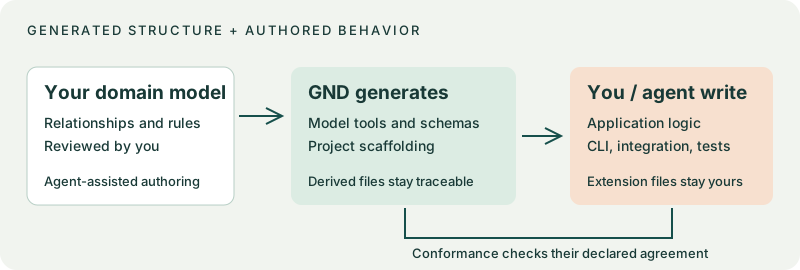
- Describe the requirements and review an agent-authored model.
- Validate it and inspect small populations, including intentional mistakes.
- Generate a Python project and write the application logic in its extension files.
- Check the produced facts or plans before deciding to publish or act on them.
- Change the model explicitly when requirements change, then check conformance.
GND supplies the model, the checker and structured workflows. A developer or coding agent supplies domain understanding and application behavior. Generated scaffolding does not invent a recommender, storage backend or user interface.
An output can be legal yet incomplete: "every recommended book is eligible" does not say "every eligible book is recommended." BookRec's final chapter adds a derivation and a completeness rule to illustrate the difference. Likewise, a valid expense state does not by itself prove the operation that produced it was authorized; that is what transition checks are for.
Read more
- ORM Foundation: Terry Halpin's ORM resources
- ORM 2 graphical notation and the ORM white paper
- Object-role modeling on Wikipedia
- NORMA, the reference ORM 2 diagramming tool for Visual Studio
- GND's own ORM reference library: the Halpin posture, constraint reference, and verbalization patterns
Credits: GND's ORM modeling skills are adapted from RelationalAI's open-source rai-agent-skills (Apache-2.0).