Release governance across three runtimes
A release manager needs three different answers: Are the approval facts valid? Which services depend on vulnerable components? Does an approval policy follow from the other rules? Checking a snapshot, computing a graph, and proving a statement answer different questions. This learning path makes each useful.
You will audit five releases, repair their approvals, trace vulnerabilities through a service graph, and complete finite Lean proofs. All names and vulnerabilities are synthetic. The snapshots do not represent a real vulnerability feed, deployment system, event history, or production release authorization.
The situation
| Release | Service / requester | Initial approval | Problem |
|---|---|---|---|
| REL-101 | checkout / Alice | Alice | Self-approval; Alice is also outside the reviewer allowlist |
| REL-102 | inventory / Ben | Maya | Valid approval |
| REL-103 | reporting / Cara | absent | Missing approval |
| REL-104 | payments / Dana | Maya and Noah | Conflicting approvals under the one-reviewer policy |
| REL-105 | ledger / Evan | Zoe | Unauthorized reviewer |
The repaired snapshot uses Noah, Maya, Maya, Maya, Noah respectively. Approval repair does not remove vulnerabilities. A separate patched snapshot clears both synthetic vulnerability facts, representing an explicitly revised catalogue.
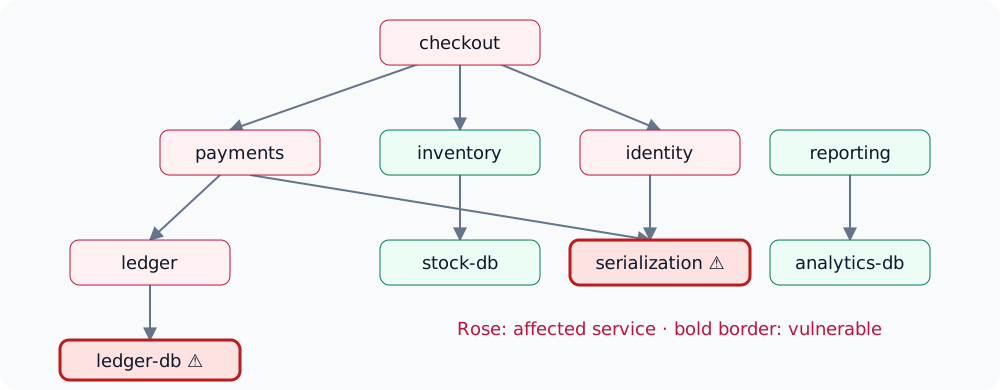
Edges point from a component to its dependency. Serialization affects checkout, payments and identity; ledger-db affects checkout, payments and ledger. Inventory and reporting are disconnected from those vulnerable components. There are ten components, six deployable services and nine base edges.
Install and provision deliberately
First install GND in its own environment. The offline parts of these guides need only GND and Python. For PyRel, clone the documentation checkout and run the following setup commands, outside the tutorial runner:
uv sync --project tutorials/runtimes --locked --only-group tutorial-runtimes --python 3.13
export GND_TUTORIAL_PYREL_PYTHON="$(pwd)/tutorials/runtimes/.venv/bin/python"
After copying the resources below, installed-wheel readers can instead use uv sync --project release-governance/runtime-environment --locked --only-group tutorial-runtimes --python 3.13 and set GND_TUTORIAL_PYREL_PYTHON to that environment’s absolute bin/python path. The packaged project and lock are exact copies of the maintained tutorial project.
This separate project locks relationalai==1.30.1, duckdb==1.5.5, and their
transitive dependencies. PyRel requires Pydantic below 2.13; GND requires 2.13.4.
Installing them together is not a supported setup. GND commands retain their GND
interpreter; native PyRel commands name the separate interpreter explicitly.
The tutorial runner also selects that interpreter for Python blocks marked
lane=pyrel; run their code with the same interpreter when following manually. Python 3.11–3.13
is supported by this tutorial runtime. No Snowflake account or API key is needed.
Install Soufflé 2.5, 64-bit POSIX, following the
official installation instructions.
Select its executable with GND_TUTORIAL_SOUFFLE=/absolute/path/to/souffle if it
is not on PATH. Confirm souffle --version reports 2.5 and 64 bits.
Provision Lean 4.34.0 from the
official release,
or install that exact toolchain with elan toolchain install leanprover/lean4:v4.34.0. Set
GND_TUTORIAL_LAKE=/absolute/path/to/lean-4.34.0/bin/lake when using an unpacked
release. lake --version must identify Lean 4.34.0. GND compilation invokes the
cached toolchain; it does not install one for you. Proofs use Lean's standard
library, with no Mathlib download.
Start in an empty working directory
The next command copies installed package resources. It works without the old source repository. Use it once per working directory; occupied destinations are refused so an exercise cannot silently replace your work.
from importlib.resources import files
from pathlib import Path
import shutil

source = files("gnd").joinpath("examples/release_governance")
shutil.copytree(Path(str(source)), "release-governance")
print("Copied the complete synthetic scenario, models, programs and checkpoints.")
import json
from pathlib import Path
from gnd.api import validate, check

root = Path("release-governance")
scenario = json.loads((root / "scenario-invalid.json").read_text())
assert len(scenario["services"]) == 6 and len(scenario["dependencies"]) == 9
assert len({x for edge in scenario["dependencies"] for x in edge}) == 10
for profile in ("policy", "dependencies", "approval-proof"):
    assert validate(root / profile / "model.orm.json")["exit_code"] == 0
assert check(root / "policy/model.orm.json", root / "policy/invalid.pop.json")["exit_code"] == 1
assert check(root / "policy/model.orm.json", root / "policy/repaired.pop.json")["exit_code"] == 0
print("All three model views validate; flawed approvals fail and repaired approvals pass.")
Three model views, three meanings
| View | Source facts and rules | What it omits |
|---|---|---|
policy/ |
Requests, approvals, reviewer allowlist; mandatory release coverage, one approval per release, allowlisted reviewer | Self-approval joins are taught in the native program; no dependency or temporal rules |
dependencies/ |
Dependency edges, deployable services, vulnerabilities, requested services; recursive reachability, exposure, negation, counts and blocked releases | All approval constraints; Soufflé export excludes constraint evaluation and operations |
approval-proof/ |
Unary requested, reviewed, approved release sets; approved ⊆ reviewed ⊆ requested and the redundant approved ⊆ requested rule | Reviewer identities and mandatory approval; pending reviewed releases are permitted |
Requests map to request rows in the first two views and requested in the
proof view. Approval release IDs map to approved in the proof view; the repaired
scenario has all five. The supplied reviewed roster maps to reviewed. These
are explicit author-selected views, not automatic model conversion.
For derivation export, *.base.pop.json supplies base facts only. The matching
*.pop.json additionally contains the checked expected derived relations.
GND's exporter refuses asserted derived rows instead of accepting an application's
answer as an input. Full base coverage means absent facts are known absent;
negation and unaffected-service results depend on that choice.
Follow with or without native tools
Continue to PyRel, Soufflé, or Lean. Each guide marks its native steps and includes checkpoints for readers without that tool. To execute the actual documented blocks from a documentation checkout:
uv run python tools/run_tutorials.py --group runtime-pyrel --lane pyrel
uv run python tools/run_tutorials.py --group runtime-souffle --lane souffle
uv run python tools/run_tutorials.py --group runtime-lean --lane lean
The default --lane offline executes only the offline prerequisites and says
which native lanes were not executed. Selecting a native lane with a missing or
wrong-version tool fails. --lane all selects all native steps; it never promotes
skipped work into a pass. Every group gets an isolated temporary working directory.
Agent prompt and handoff
Use
gnd-model-from-textto review the stated release problem and explain the three supplied model views. Do not merge their omitted policies. Stop after model review. I will explicitly selectgnd-exportfor a chosen view next.
The agent workflow guide explains the handoff. You can follow every checkpoint without calling an agent. As an exercise, add an unrelated service and predict which view needs new facts before running any tool.