Find the rule your auditors are really using
A shop's refund policy says no refund over 1000. Its auditors looked at one week of refunds from each of eight stores and flagged four weeks. The written rule explains only two of them. So the auditors are applying a rule nobody has written down.
On this page you ask Claude Code to find that rule, let GND check every claim made about it, and add it to the model as an advisory rule. You type requests; GND does the checking. All the data is synthetic.
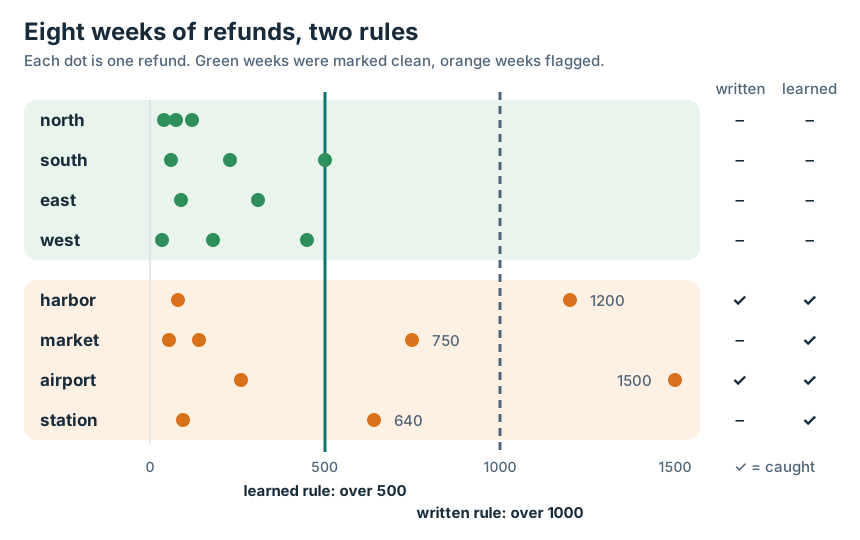
Source: the shipped refunds example and the auditors' verdicts in
labels.json. Every number on this page comes from a real run of the
commands behind it.
On narrow screens, focus a diagram and scroll horizontally with arrow keys or touch.
The result in one table
| Flagged weeks caught | Clean weeks accused | |
|---|---|---|
| The written rule: no refund over 1000 | 2 of 4 | 0 of 4 |
| The learned rule: no refund over 500 | 4 of 4 | 0 of 4 |
The rest of the page is how you get there, and how GND makes sure nobody, human or program, slips a rule past you.
Who does what
| Who | Does what |
|---|---|
| The auditors | mark each store's week clean or flagged |
| You | ask Claude Code, read the answers, decide |
| Claude Code | runs GND's commands, and the gnd-model-evolve skill when the model changes |
| A rule learner | looks for a rule that separates flagged weeks from clean ones |
| GND | scores rules, re-checks the learner's claims, and refuses what it cannot reproduce |
Nothing becomes a rule because a program found it. GND writes every suggestion as a proposal, and only you can accept one.
Files on GitHub
refunds/model.orm.yaml: the model and the written rulerefunds/batches/: one week of refunds from each storerefunds/labels.json: the auditors' verdictsrefunds/stand_in_learner.py: the example's stand-in rule learner (not a GND command)gnd-model-evolve: the skill's instructions- this page's Markdown source
Before you start. Install GND from PyPI as the installation page
shows, or from a checkout of the repository for unreleased work on main, as the course planner's "Before you start"
shows. Add the Claude Code plugin as the plugin page
shows, then copy the refunds example into an empty folder. The
commands page has the copy step and every
command Claude Code runs below. No prompt on this page is a recording; the
results are what GND printed when those commands ran.
The data
Eight weeks, one per store. Each number is one refund.
| Store | Refunds that week | The auditors said |
|---|---|---|
| north | 40, 120, 75 | clean |
| south | 500, 60, 230 | clean |
| east | 310, 90 | clean |
| west | 450, 35, 180 | clean |
| harbor | 1200, 80 | flagged |
| market | 750, 140, 55 | flagged |
| airport | 1500, 260 | flagged |
| station | 640, 95 | flagged |
With eight weeks you can see the pattern yourself: every flagged week has a refund over 500, and no clean week does. With eight hundred weeks, or a pattern that spans customers and payment methods, nobody can. That search is a rule learner's job. Checking the learner is GND's.
1. How good is the written rule?
You type
Score the written refund rule against the auditors' verdicts in labels.json.
How many flagged weeks does it catch, and does it ever accuse a clean week?
Claude Code does run GND's measure command over the eight weeks and the verdicts. There is no skill for this step; it is one command.
GND says
| The written rule: no refund over 1000 | Flagged weeks | Clean weeks |
|---|---|---|
| fired | 2 of 4 (harbor, airport) | 0 of 4 |
| stayed quiet | 2 of 4 (market, station) | 4 of 4 |
Good news: the rule never accuses a clean store. Bad news: it lets half the flagged weeks through. Market's 750 and station's 640 are under 1000.
2. Ask a rule learner what the auditors see
You type
Export the labelled weeks for a rule learner, run the stand-in learner on them,
and tell me the rule it finds.
Claude Code does ask GND to pack the labelled weeks into files a learner can read, then runs the example's stand-in learner on them. A real learner such as Popper reads the same files. The stand-in tries 40 simple rules of the form "a week is wrong when it has a refund above (or below) some amount". From those that touch no clean week, it picks a small set, one rule at a time, until every flagged week is explained.
The learner says
A week is wrong when one of its refunds is over 500. This covers harbor, market, airport and station.
That is the learner's claim. Nobody has checked it yet.
3. GND checks the learner's work
You type
Bring the learned rule into GND as a proposal. Check its coverage on every
week yourself before you believe the learner.
Claude Code does ask GND to import the learned rule. GND does not take the learner's word: it runs the rule on all eight weeks and compares what it finds with what the learner reported.
GND says the claim holds. The rule covers exactly the four flagged weeks, support 4 of 4, and no clean week. GND writes the rule into a proposal. In plain English: a refund amount is at most 500. Nothing in the model has changed yet.
| Rule | Flagged weeks caught | Clean weeks accused |
|---|---|---|
| The written rule: at most 1000 | 2 of 4 | 0 of 4 |
| The learned rule: at most 500 | 4 of 4 | 0 of 4 |
4. A learner that overstates its rule
Learners have bugs, and run reports get edited by hand. Here the stand-in plays a faulty learner: it also claims its rule covers the clean north week.
You type
Run the stand-in learner again, this time as the faulty learner that also
claims north. Try to import what it produces.
GND says no.
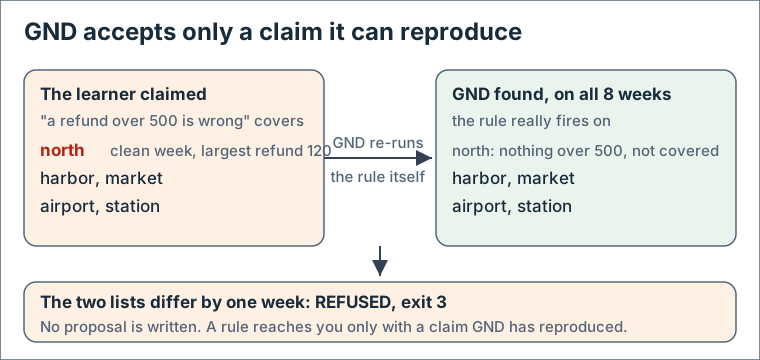
What went wrong: the learner said the rule covers north. North's largest refund is 120, so a rule about refunds over 500 cannot fire there.
How GND caught it: GND does not count, it compares. It ran the rule on every week, listed the weeks the rule really covers, and set that list beside the learner's. They differed by one week, north. GND refused the import and wrote no proposal. A rule only reaches you with a claim GND has reproduced.
5. What does one clean week say on its own?
The learner needs verdicts. GND can also suggest rules from a single clean week, with no verdicts at all.
You type
Look at south's week alone and suggest rules of two kinds: "each X has exactly
one Y" and "every X has a Y". Read each suggestion back to me in plain English.
Claude Code does run GND's discover command on the south week. There is no skill for this step; it is one command, and the proposal it writes is reviewed in step 6 like any other.
GND says ten rules held in that week. It left out four more on its own: one is already in the model (each refund has one customer), and three are true of any list of facts, so they say nothing. Read in plain English, the ten fall into three groups:
| How many | The suggested rules | What to make of them |
|---|---|---|
| 5 | Each refund has one amount. Each refund is paid one way. Every refund has a customer, an amount and a payment method. | sensible: worth accepting |
| 2 | Each customer asks for at most one refund. No two refunds have the same amount. | accidents: true of three refunds in one week, false in general |
| 3 | Every customer, amount and payment method in the file belongs to some refund. | how the file is written, not a business rule |
This is why discovery writes proposals, not rules. A small sample makes accidents look like laws, and only someone who knows the business can tell them apart. Constraint discovery explains how GND finds them and the five other kinds of rule it can look for.
6. Review and decide
Now the model changes, so the gnd-model-evolve skill takes over. It previews
each proposal, shows what it would change, and applies only what you accept.
You type
/gnd:gnd-model-evolve Review learned.proposal.json and discovered.json with me.
Preview both, explain each rule in plain English, and apply only the ones I accept.
Claude Code does preview both proposals with GND, which checks that each proposal still matches the model it was written against and reports its blast radius.
GND says neither proposal is breaking: each only adds rules, and nothing already in the model changes or disappears. You accept the learned rule and leave the discovered proposal for a closer look.
You get a model that holds the new rule. In plain English: if a refund has an amount, that amount is at most 500. The rule carries three labels:
| Label | Meaning |
|---|---|
| induced | a program found it |
| proposed | no one has confirmed it yet |
| advisory | breaking it gives a warning, not an error |
The model also records where the rule came from: the learner's name, the four weeks it covers, and a fingerprint (digest) of each file the claim was checked against, so a later change to those files can be detected.
Check the market week again, the one the written rule missed:
GND says
| Market's week: 750, 140, 55 | Before | After |
|---|---|---|
| The written rule: at most 1000 | quiet | quiet |
| The learned rule: at most 500 | not in the model | warning on refund 601, for 750 |
The written rule is still there, and still quiet. If a later review confirms the new rule, a refund over 500 is something the shop warns about everywhere the model is used.
What you did
| Step | What happened | You asked for | Who checked it |
|---|---|---|---|
| 1 | the written rule caught 2 of the 4 flagged weeks | a plain request | GND, against the auditors' verdicts |
| 2 | a learner found "a refund over 500 is wrong" | a plain request | nobody yet: a learner's claim |
| 3 | the rule covered exactly the four flagged weeks | a plain request | GND re-ran it on every week |
| 4 | an overstated claim was refused | a plain request | GND, comparing week by week |
| 5 | one clean week suggested ten rules, two of them accidents | a plain request | GND; you sort them |
| 6 | you accepted the learned rule; market's 750 now gets a warning | the gnd-model-evolve skill |
GND, before and after the change |
The commands behind this page show every GND command Claude Code runs for these requests, with the output of a real run.
What this does not establish
- That the learned rule is right. It fits these eight weeks. A rule that fits labelled examples can still be wrong on weeks nobody has labelled. GND checks that claims about the rule are exact, not that the rule is wise.
- That the auditors were right. GND measures a rule against their verdicts; it cannot tell you whether the verdicts were correct.
- Anything about a real learner. The stand-in is not Popper. The ILP bridge describes what a real learner reads and writes; this page has not run one.