From several documents to one checked answer
A program that reads contracts extracts each one on its own: one document, one population, one anchor sidecar that says where in the text each value was found. Some questions need two documents at once. Which city is each contract's party based in, when one contract names the party and another says where it is based? In this how-to, GND composes two extractions into one population, checks the result against both documents, and traces the answer back to a passage in each.
Three rules hold the whole way through. GND never decides on its own that two values mean the same thing; a manifest says so, and nothing else changes. Every anchored value is checked against the document it came from, under the name that document uses. The record of where each composed fact came from carries ids and indexes, never a value, so it can travel where the contracts cannot.
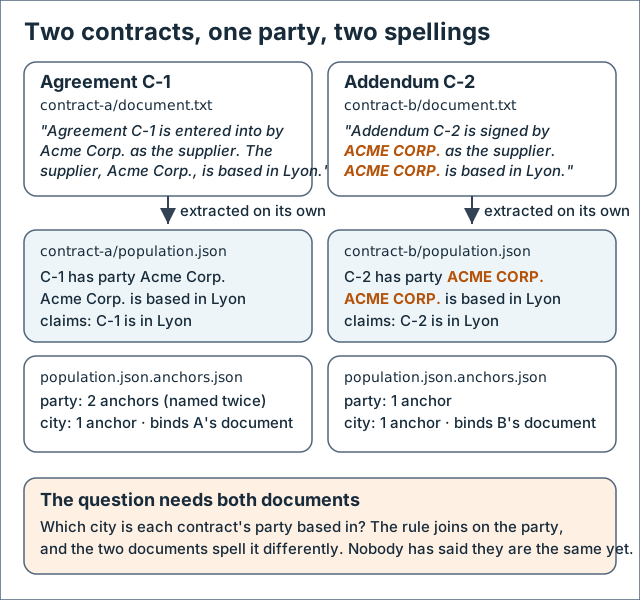
Source: contracts/composition/contract-a and contract-b of the shipped example.
Files on GitHub
composition/model.orm.yaml: contracts, parties and cities, ananchoredparty and city, a uniqueness and the derived "Contract is in City"composition/composition/: the composition directory, withmanifest.jsonand one folder per contract holdingdocument.txt,population.jsonandpopulation.json.anchors.jsoncomposition/composition-conflict/: the same, except that the addendum says Zurichcomposition/targets.json: the derived fact to trace- this page's Markdown source
Copy the example into a working folder:
python -c "import gnd, pathlib, shutil; shutil.copytree(pathlib.Path(gnd.__file__).parent / 'examples/composition', 'contracts', dirs_exist_ok=True)"
The model
Three value types, Contract, Party and City, and three fact types. "Contract
has party Party" carries an anchored constraint on the party: every party
must be found in the document its fact was extracted from. "Party is based in
City" anchors the city the same way and adds a uniqueness: a party has one
seat. The third fact type is derived, and it is the question:
python -c "from gnd import api; [print(r['fact_type'], '->', r['text']) for r in api.verbalize_rules('contracts/model.orm.yaml')['rules']]"
contract_is_in_city -> when contract_has_party(contract = $c, party = $p) and party_is_based_in_city(party = $p, city = $x), derive (contract = $c, city = $x)
The rule joins on the party. It only answers when both premises name the party the same way, which is the whole difficulty of reading two documents.
Two documents, two extractions
The agreement:
Agreement C-1

Agreement C-1 is entered into by Acme Corp. as the supplier.
The supplier, Acme Corp., is based in Lyon.
The addendum, which writes the same company in capitals:
Each document was extracted on its own: a population of the facts the
document states, and beside it an anchor sidecar. No gnd command writes the
sidecar; the extractor does, whether that is you, an agent, or your own
tooling, and gnd.anchors.write_anchor_sidecar publishes one that the
parser accepts. This example's sidecars come from
tools/build_composition_example.py,
which computes every digest and range from the files.
An anchor binds one role value of one fact to a range of the document's text; the value's chosen occurrence must lie inside that range. That is all an anchor claims. It does not say the passage entails the fact, and GND does not say so either.
The agreement names Acme Corp. twice, so its sidecar (version 2, which allows several anchors per fact role) carries two anchors on the party of "C-1 has party Acme Corp.", one per sentence, and one anchor on the city:
python -c "import json; d=open('contracts/composition/contract-a/document.txt').read(); [print(a['role'], a['occurrence'], repr(d[a['span']['start']:a['span']['end']])) for a in json.load(open('contracts/composition/contract-a/population.json.anchors.json'))['anchors']]"
party 0 'Agreement C-1 is entered into by Acme Corp. as the supplier.'
party 1 'The supplier, Acme Corp., is based in Lyon.'
city 0 'The supplier, Acme Corp., is based in Lyon.'
Every anchor on a role must hold for the role to pass. Two anchors are two claims about the document, and one wrong claim fails the fact even when the other is right.
The sidecar also carries three digests (fingerprints of exact content): of the population's bytes, of the document's bytes, and of the model's vocabulary, meaning its object types, fact types and roles but not its constraints, rules or descriptions. If the population, the document or that vocabulary changes, the sidecar no longer binds and GND refuses it before looking at a single value. The composition record, below, binds the whole model file.
Each extraction also claims the answer its own document supports: the agreement's population lists "C-1 is in Lyon" and the addendum's lists "C-2 is in Lyon". The checker will compare those claims with what the rule derives from the composed facts.
Say what is the same, in the manifest
You type. With Claude Code, the ask is one paragraph:
Compose contracts/composition under contracts/model.orm.yaml. The addendum
writes the supplier as "ACME CORP."; that is "Acme Corp." from the agreement.
Check the composition against both documents and tell me which city each
contract's party is based in, with the passage each answer rests on.
Claude Code does. It writes the manifest, then runs the four commands below. The manifest lists the sources in reading order, the renamings, and the deduplication rule:
{
  "schema": "gnd-composition-manifest/1",
  "sources": [
    "contract-a",
    "contract-b"
  ],
  "renamings": [
    {
      "source": "contract-b",
      "fact_type": "contract_has_party",
      "role": "party",
      "from": "ACME CORP.",
      "to": "Acme Corp."
    },
    {
      "source": "contract-b",
      "fact_type": "party_is_based_in_city",
      "role": "party",
      "from": "ACME CORP.",
      "to": "Acme Corp."
    }
  ],
  "deduplications": "identical-rows",
  "scope_tags": [
    {
      "source": "contract-a",
      "tag": "agreement"
    },
    {
      "source": "contract-b",
      "tag": "addendum"
    }
  ]
}
A renaming names one source, one fact type, one role, and the exact value to rewrite. It is the only way composition changes a value. GND will not match "ACME CORP." to "Acme Corp." by case, by edit distance or by any other guess, because a program that guesses once will guess wrong once, silently, in a population that then looks checked.
A renaming that matches no row is refused, so a manifest cannot carry a stale rule. The scope tags label each source in the record and change nothing in the population.
Compose
gnd compose contracts/model.orm.yaml contracts/composition --out composed.population.json --record composition.json
For each source in manifest order, GND validates the population against the model, binds the sidecar to the population and the document, and applies the renamings. Then it appends the rows fact type by fact type. The two "is based in Lyon" rows are identical once the addendum's party is renamed, so they become one composed fact with two source facts.
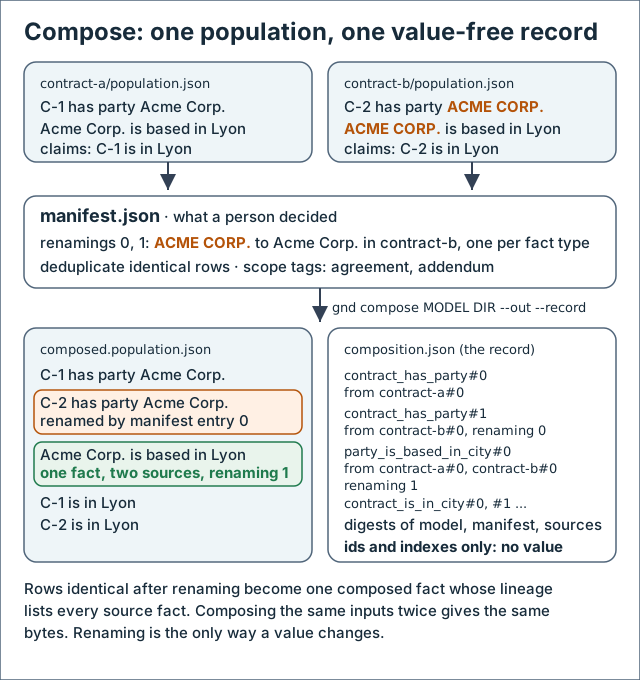
Source: the manifest above and the record printed below.
You get. Two files. composed.population.json is an ordinary population,
written as canonical JSON so that composing the same inputs again gives the
same bytes. composition.json is the record: for every composed fact, the
source facts it came from and the manifest renamings applied to it, by index.
The helper below prints one line per composed fact:
python -c "import json; [print(f['fact_type'], f['index'], [s['source'] + '#' + str(s['fact_index']) for s in f['sources']], 'renamings', f['renamings']) for f in json.load(open('composition.json'))['facts']]"
contract_has_party 0 ['contract-a#0'] renamings []
contract_has_party 1 ['contract-b#0'] renamings [0]
contract_is_in_city 0 ['contract-a#0'] renamings []
contract_is_in_city 1 ['contract-b#0'] renamings []
party_is_based_in_city 0 ['contract-a#0', 'contract-b#0'] renamings [1]
The record holds no role value: not "Acme Corp.", not "Lyon", not the
contract codes. It holds digests of the model, the manifest, every source's
three files and the composed population, plus ids and indexes. A record can be
handed to an auditor, logged, or compared across runs without disclosing what
the contracts say. The values stay in the populations: gnd compose writes
them in every mode, and disclosure mode governs
only what a check, witness view or other report prints about them.
Check the composition against both documents
gnd check contracts/model.orm.yaml composed.population.json --composition composition.json --sources contracts/composition
BLOCKING (alethic)
  (none)
ADVISORY (deontic)
  (none)
DERIVATIONS (alethic)
  [pass] derivation:contract_is_in_city: The derivation claim for 'contract_is_in_city' matches its extension.
pass=4 fail=0 warning=0 unchecked=0 vacuous=0
COVERAGE
  contract_has_party: declared, facts=2
  party_is_based_in_city: declared, facts=1
  contract_is_in_city: declared, facts=2
GND says. Clean. Before it checks anything, the checker does two things the record makes possible. It compares the model's and the composed population's digests with the record, so a population edited after composition is refused. Then it composes again from the sources directory, binding every sidecar again, and compares the result byte for byte with the record: manifest digest, every source digest, scope tags and lineage. The checker runs over exactly the bytes it just re-derived, not over bytes it was told came from the sources.
Only then do the constraints run, and the anchored ones run per source. The
composed population says contract C-2 has party "Acme Corp.", but the
addendum's document never contains those words:
So GND does not look for the composed value in the addendum. It takes the source fact as it was before renaming, "C-2 has party ACME CORP.", and matches it against the addendum's own sidecar and document. A renaming is a decision about meaning, taken in the manifest; the evidence for the value is in the document that used the old spelling, and that is where it is checked. A composed fact passes when every one of its source facts passes.
The derivation line says the claims and the rule agree: joining the two contracts' parties with the one seat gives "C-1 is in Lyon" and "C-2 is in Lyon", exactly what the two extractions claimed.
When the documents disagree
contracts/composition-conflict is the same pair of contracts, except that
the addendum now says the supplier is based in Zurich:
Composition still succeeds. It does not check constraints, and it does not pick a city. Both rows compose, one from each contract:
gnd compose contracts/model.orm.yaml contracts/composition-conflict --out conflict.population.json --record conflict.json
The check is where the disagreement surfaces:
gnd check contracts/model.orm.yaml conflict.population.json --composition conflict.json --sources contracts/composition-conflict
BLOCKING (alethic)
  [fail] fact_types[party_is_based_in_city].constraints[1]: Each party plays 'party_is_based_in_city' with at most one combination of the other roles — violated: party 'Acme Corp.' has 2 facts.
ADVISORY (deontic)
  (none)
DERIVATIONS (alethic)
  [fail] derivation:contract_is_in_city: The derivation claim for 'contract_is_in_city' differs from its extension.
    [derived-extension-incomplete] The derived extension of 'contract_is_in_city' is incomplete — missing {"contract":"C-1","city":"Zurich"}.
pass=2 fail=2 warning=0 unchecked=0 vacuous=0
COVERAGE
  contract_has_party: declared, facts=2
  party_is_based_in_city: declared, facts=2
  contract_is_in_city: declared, facts=2
lineage party_is_based_in_city#0: contract-a:party_is_based_in_city#0
lineage party_is_based_in_city#1: contract-b:party_is_based_in_city#0
GND says. Two failures, and where each side came from. The
uniqueness fails because the composed population now holds two seats for one
party. The two lineage lines name the offending facts' sources: row 0 is
the agreement's fact, row 1 is the addendum's. A person can open the two
passages and decide; GND cannot, and does not try. Every anchor still passes,
because each document really does say what its extraction recorded. Nothing
was extracted wrongly. The two documents disagree.
The derivation failure shows why a conflict is never quietly tolerated. With two seats for Acme Corp., the rule derives a second city for each contract: "C-1 is in Zurich", though the agreement never mentions Zurich, and "C-2 is in Lyon" beside "C-2 is in Zurich".
The derived extension is every row the rule
produces; the check names only the first one the extractions did not state; the others are missing in the same way.
Whichever seat is wrong, it changes the answer for a contract its document
does not even name. The lineage lines are in the JSON report too, as the
entries of composition.lineage, one per offending fact.
Trace the answer to both documents
Back to the clean composition. "C-2 is in Lyon" rests on a premise from each
document: the addendum names the party, and both say where it is based.
gnd witness writes a finite proof of a derived fact; with --composition
it is a version-2 witness. Its base nodes are the stated facts the proof
starts from, and each one names the source facts the record lists for it:
gnd witness contracts/model.orm.yaml composed.population.json --targets contracts/targets.json --composition composition.json --raw --out witness.json >/dev/null
The witness proves the target from two base facts, each with its sources:
python -c "import json; [print(n['fact_type'], [s['source'] + ':' + s['fact_type'] + '#' + str(s['fact_index']) for s in n['sources']]) for n in json.load(open('witness.json'))['nodes'] if n['kind'] == 'base']"
party_is_based_in_city ['contract-a:party_is_based_in_city#0', 'contract-b:party_is_based_in_city#0']
contract_has_party ['contract-b:contract_has_party#0']
Each source fact has anchors in its own sidecar, and those anchors locate spans in its own document. Following them is a few lines of Python: for each base node, open the source's population to find the row, find the anchors in the source's sidecar whose fact key is that row, and slice the document.
import json
from pathlib import Path

witness = json.loads(Path("witness.json").read_text())
for node in witness["nodes"]:
    if node["kind"] != "base":
        continue
    for entry in node["sources"]:
        folder = Path("contracts/composition") / entry["source"]
        row = json.loads((folder / "population.json").read_text())["facts"][entry["fact_type"]][entry["fact_index"]]
        sidecar = json.loads((folder / "population.json.anchors.json").read_text())
        text = (folder / "document.txt").read_text()
        for anchor in sidecar["anchors"]:
            if anchor["fact_key"]["roles"] == row:
                span = anchor["span"]
                print(entry["source"], anchor["role"] + ":", repr(text[span["start"]:span["end"]]))
contract-a city: 'The supplier, Acme Corp., is based in Lyon.'
contract-b city: 'ACME CORP. is based in Lyon.'
contract-b party: 'Addendum C-2 is signed by ACME CORP. as the supplier.'
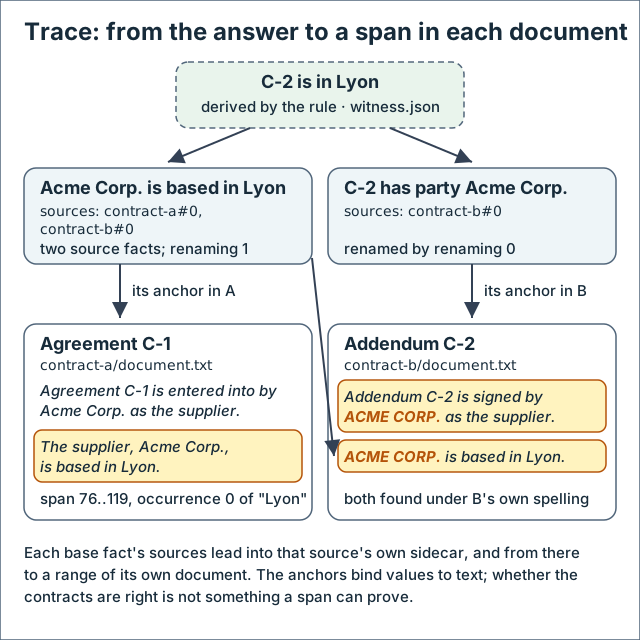
Source: witness.json and the three spans printed above.
Notice that the addendum's row says "ACME CORP." and its sidecar is matched on that row, not on the composed "Acme Corp.". The trace crosses the renaming in the right direction: from the composed answer, through the record, to the spelling each document actually uses.
A witness can be replayed later against the same population and record.
gnd replay checks the digests the witness binds, then that every base node's sources
are what the record says, then the proof itself:
gnd replay contracts/model.orm.yaml composed.population.json witness.json --composition composition.json
{"exit_code": 0, "kind": "derivation-witness-view", "reason": null, "replayable": false, "results": [{"reason": null, "request_index": 0, "root": 2, "status": "proved"}], "work": {"binding_cells": 3, "edges": 2, "nodes": 3, "proof_depth": 2}}
A version-2 witness without its record is refused rather than replayed as if the lineage did not matter:
{"exit_code": 3, "kind": "derivation-witness-view", "reason": "composition-required", "replayable": false, "results": [], "work": {}}
"status": "proved" is the verdict. "replayable": false describes this
printed summary, not the witness: a summary is never fed back to replay, the
witness.json file is.
Replay checks the witness against the record; only gnd check --composition
--sources re-derives the record from the sources. Run the check before
trusting a record, and replay after.
What this proves, and what it does not
The composition and its check establish that the composed population is exactly what the manifest says about those source files, that every anchored value is found in its own document where its sidecar says, and that the constraints and the derived claims hold over the result. The witness establishes that "C-2 is in Lyon" follows from two base facts by the model's rule, and names the passages those facts were read from.
None of it establishes that the contracts are right. An anchor binds a value to a range of text, nothing more; a document can state a false seat, and an extraction can read a true document wrongly in a way the anchors do not catch. The renaming is a human decision recorded in a manifest, not a finding.
What GND adds is that every step is explicit, re-derivable, and refused when its inputs change, so that the decisions a person did make, the renaming and the choice of sources, are stated where anyone can check them.
Recap
| Step | Command | What GND holds you to |
|---|---|---|
| Say what is the same | manifest.json |
a renaming is explicit and must match a row |
| Compose | gnd compose |
one population, one value-free record, same bytes every time |
| Check | gnd check --composition --sources |
re-derived from the sources; each value checked in its own document |
| Disagree | the same check | the violation, with the source of every offending fact |
| Trace | gnd witness --composition |
each premise's source facts, hence a span in each document |
| Replay | gnd replay --composition |
the proof and the lineage, against the same record |
Next steps
- The directory layout, the manifest, the record and every exit are in the composition reference; the sidecar format and the every-anchor rule are in anchor sidecars.
- The witness format, including the version-2
sourcesandcomposition_sha256fields, is in the witness contract. - When a composed population lands many facts in a generic "item has attribute
with value" fact type, declared generic in its
provenance,gnd discover --families fact-typeproposes proper fact types for recurring attributes, as a reviewed additive proposal: proposing fact types from generic rows. Whether an attribute repeats a fact type you already have, or holds several values per item, is judged by two skills: judge induced fact types with two skills. - The extraction half, one document at a time, is the
gnd-extractskill in the agent skill guide; a model that grows as documents arrive is grow a model by additions.