Lean: prove a finite policy and find a counterexample
Use this when checking one successful snapshot is insufficient: you want to know whether one policy follows from the others. Continue from the shared setup. You will inspect generated propositions, complete three proofs, and refute an incorrect implication. The application is a small approval-policy library.
Select a finite policy view
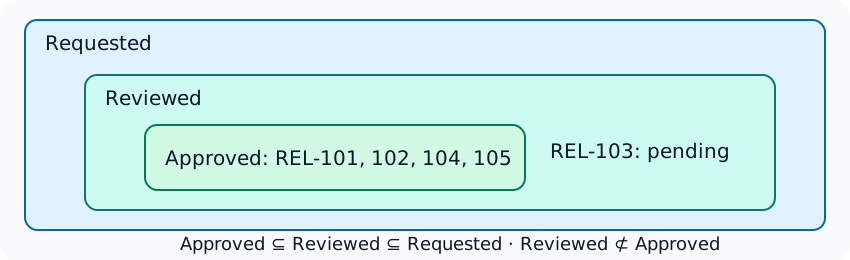
Our proof view states approved ⊆ reviewed, reviewed ⊆ requested, and approved ⊆ requested. The third rule should follow from the first two. A pending release may be reviewed without being approved. This view deliberately omits the audit model's mandatory approval rule and reviewer identity policies.
The diagram shows the pending counterexample used later in the guide.
The selected GND exporter accepts finite value carriers and positive acyclic rules. It cannot export the recursive dependency graph from the previous guide. That is a supported-profile boundary, not evidence that the graph is false.
gnd export lean release-governance/dependencies/model.orm.json release-governance/dependencies/repaired.base.pop.json --toolchain leanprover/lean4:v4.34.0 --raw --out unsupported-recursive-lean --json
gnd export lean release-governance/approval-proof/model.orm.json release-governance/approval-proof/repaired.pop.json --toolchain leanprover/lean4:v4.34.0 --raw --out lean-approval --json
gnd export lean-verify lean-approval --json
import json
from pathlib import Path
assert not Path("unsupported-recursive-lean").exists()
source = json.loads(Path("lean-approval/source-map.json").read_text())
obligations = json.loads(Path("lean-approval/obligations.json").read_text())
assert source["carriers"][0]["values"][2] == {"ordinal": 2, "value": "REL-103"}
assert source["relations"] == [{"address": "/fact_types/0", "symbol": "r0"}, {"address": "/fact_types/1", "symbol": "r1"}, {"address": "/fact_types/2", "symbol": "r2"}]
assert obligations["constraints"][2]["id"] == "approved_requested"
assert obligations["constraints"][2]["proposition"] == "redundant2"
assert all(c["status"] == "unproved" for c in obligations["constraints"])
print("Source map: r0 requested, r1 reviewed, r2 approved; ordinal 2 is REL-103.")
Definitions.lean defines Population, finite carrier Fin 5, relation lists,
constraint outcomes, and propositions. ProofObligations.lean contains explicit
by sorry templates. The export has not proved those propositions.
| Proposition | What it asks |
|---|---|
concreteWitness |
Is this supplied population well typed, nonempty, and hard-policy compliant? |
satisfiability |
Does some population over these finite carriers satisfy those conditions? |
redundant2 |
For every well-typed population, do the other hard constraints imply approved ⊆ requested? |
The lists can vary; the proof of redundancy quantifies over their interpretations, not just our one concrete snapshot. Carriers remain fixed to these five IDs. Concrete validity alone would not answer the universal redundancy question.
Compile definitions and recognize unproved templates
These commands require the provisioned Lean 4.34.0 toolchain:
gnd export lean-compile lean-approval --executable "${GND_TUTORIAL_LAKE:-lake}" --elaborate-stubs --json > lean-compile.json
import json
from pathlib import Path
result = json.loads(Path("lean-compile.json").read_text())
assert result["exit_code"] == 0 and result["status"] == "compiled"
assert result["proof_status"] == "unproved"
assert result["definitions"]["status"] == result["stubs"]["status"] == "completed"
print("Definitions and templates elaborate; proof status remains unproved.")
Lean accepts sorry as a placeholder. A zero compiler exit from a template is
therefore insufficient. We now create separate developer-owned proof sources
that import only verified definitions, leaving the bundle unchanged.
from pathlib import Path
import shutil
proofs = Path("approval-proofs")
proofs.mkdir()
for name in ("Definitions.lean", "lean-toolchain"):
    shutil.copy2(Path("lean-approval") / name, proofs / name)
for name in ("Proofs.lean", "FalseClaim.lean"):
    shutil.copy2(Path("release-governance") / name, proofs / name)
print("Copied verified definitions and developer-owned proofs; templates are not imported.")
Complete proofs using ordinary tactics
import Definitions

namespace ReleaseProof
open GND

-- This relates the generated Outcome-based predicate to ordinary list inclusion.
theorem holds_subset (xs ys : List T0) :
    holds (if xs.isEmpty then .satisfied else
      if xs.all (fun r => ys.contains r) then .satisfied else .violated) = true ↔
    xs.all (fun r => ys.contains r) = true := by
  cases xs with
  | nil => simp [holds]
  | cons a xs =>
    cases (a :: xs).all (fun r => ys.contains r) <;> simp [holds]

theorem subset_trans (xs ys zs : List T0)
    (hxy : xs.all (fun r => ys.contains r) = true)
    (hyz : ys.all (fun r => zs.contains r) = true) :
    xs.all (fun r => zs.contains r) = true := by
  apply List.all_eq_true.mpr
  intro r hr
  have hmem : r ∈ ys := by simpa using List.all_eq_true.mp hxy r hr
  exact List.all_eq_true.mp hyz r hmem

theorem candidate_valid : concreteWitness := by
  unfold concreteWitness
  decide

theorem policy_satisfiable : satisfiability := by
  exact ⟨concrete, candidate_valid⟩

-- c2 is approved ⊆ requested. without2 contains c0 and c1 only.
theorem approval_requested_redundant : redundant2 := by
  intro p _ h
  have both : holds (c0 p) = true ∧ holds (c1 p) = true := by
    simpa [without2] using h
  have approved_reviewed := (holds_subset p.r2 p.r1).mp both.1
  have reviewed_requested := (holds_subset p.r1 p.r0).mp both.2
  exact (holds_subset p.r2 p.r0).mpr
    (subset_trans p.r2 p.r1 p.r0 approved_reviewed reviewed_requested)

-- Carrier ordinal 2 maps to REL-103 in source-map.json. It is pending.
def pending : Population := { concrete with r2 := [0, 1, 3, 4] }

def reviewedImpliesApproved : Prop :=
  ∀ p : Population, wellTyped p = true → hard p = true →
    p.r1.all (fun r => p.r2.contains r) = true

theorem reviewed_does_not_imply_approved : ¬ reviewedImpliesApproved := by
  intro claim
  have falseConclusion : pending.r1.all (fun r => pending.r2.contains r) ≠ true := by decide
  exact falseConclusion (claim pending (by decide) (by decide))

#print axioms candidate_valid
#print axioms policy_satisfiable
#print axioms approval_requested_redundant
#print axioms reviewed_does_not_imply_approved

end ReleaseProof
candidate_valid uses decide to reduce the concrete finite calculation in the
kernel. policy_satisfiable supplies that concrete population as an existential
witness. approval_requested_redundant uses subset transitivity: an approved
release is reviewed, and every reviewed release is requested.
The helper holds_subset connects GND's generated Outcome predicate to list
membership. It is not a replacement generated model. The theorem uses the actual
redundant2 proposition, so a change to the definitions can break the proof.
(cd approval-proofs && export LEAN_PATH="$PWD" && "${GND_TUTORIAL_LAKE:-lake}" env lean -o Definitions.olean Definitions.lean && "${GND_TUTORIAL_LAKE:-lake}" env lean Proofs.lean > proof-audit.txt)
Refute the tempting converse
REL-103 is requested and reviewed but pending. Its approval is removed in the
proof's pending interpretation. This interpretation satisfies all three subset
policies; it disproves “every reviewed release is approved.”
The following deliberately false proof must fail:
import Definitions

open GND
def pending : Population := { concrete with r2 := [0, 1, 3, 4] }

-- Deliberate failure: REL-103 is reviewed but absent from approved.
theorem every_reviewed_release_is_approved :
    pending.r1.all (fun r => pending.r2.contains r) = true := by decide
(cd approval-proofs && export LEAN_PATH="$PWD" && "${GND_TUTORIAL_LAKE:-lake}" env lean FalseClaim.lean > false-claim.txt 2>&1)
from pathlib import Path
text = Path("approval-proofs/false-claim.txt").read_text()
assert "decide" in text and "false" in text.lower()
audit = Path("approval-proofs/proof-audit.txt").read_text()
for theorem in ("candidate_valid", "policy_satisfiable", "approval_requested_redundant", "reviewed_does_not_imply_approved"):
    assert "ReleaseProof." + theorem in audit
assert all(forbidden not in audit for forbidden in ("sorryAx", "Lean.ofReduceBool", "Lean.ofReduceNat"))
print(text.strip())
print(audit.strip())
reviewed_does_not_imply_approved completes the repair by proving the negation
using that counterexample. The #print axioms output audits theorem dependencies,
including dependencies inherited through helpers. Completed sources use no added
axioms, sorry, or native_decide. Ordinary foundational axioms, if reported,
remain visible; this is not a claim to eliminate Lean's trusted foundation.
The original bundle still verifies and its obligation metadata remains unproved. The completed tutorial theorems are separate evidence, not a new GND proof replay command or assurance upgrade. A real release policy may require richer domains than this finite exporter profile supports.
Exercise and explicit handoff
Exercise: remove the reviewed ⊆ requested assumption from the redundancy theorem. Construct an approved and reviewed release absent from requested, then observe why the implication no longer holds. Keep the generated definitions unchanged and write the experiment in a new developer-owned proof file.
Use
gnd-exportfor the supplied finite policy view and verify its bundle. I explicitly select Lean compilation. Then hand off proof authoring: import verified definitions into a separate workspace, complete the selected theorems, test the false claim, and audit dependencies. Do not mark generated templates proved or claim unrestricted ORM entailment.
Read the official proof validation guide and Theorem Proving in Lean. Continue to interpret the combined release evidence.