Grow a model by additions, with GND checking each round
A model does not have to be written in one sitting. In this how-to a program
grows a shop's model one document at a time. A short note arrives, the program
(an LLM behind the gnd-model-evolve skill, or your own code) proposes what the
note adds, and GND checks the round before anything is published.
The one rule of a growing model is that each round only adds. A rename, a delete, or a new constraint on facts the model already holds would change what earlier facts mean, and the rounds that produced them could no longer be trusted. GND checks that for you, round by round, for the facts it can see (below), and it points out when a new fact type looks like one you already have.
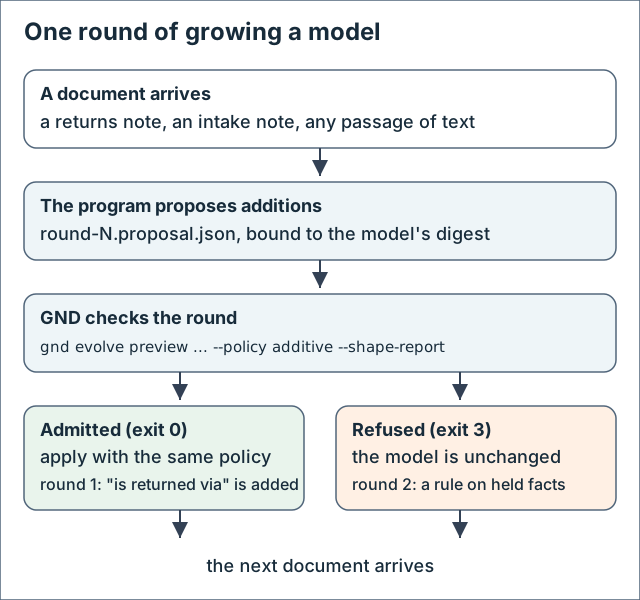
Source: the two shipped rounds of the growth example, run below.
Files on GitHub
growth/model.orm.yaml: the shop's model with two sample orders and one derived fact typegrowth/round-1.document.txtandround-1.proposal.json: a returns note, and the addition "Order is returned via Channel" proposed from itgrowth/round-2.document.txtandround-2.proposal.json: an intake note, and the mandatory rule proposed from it- this page's Markdown source
Copy the example into a working folder:
python -c "import gnd, pathlib, shutil; shutil.copytree(pathlib.Path(gnd.__file__).parent / 'examples/growth', 'growth', dirs_exist_ok=True)"
The model you start with
The shop knows customers, orders and channels. Two fact types connect them, and a third is derived: a customer who has placed an order is active. GND already holds two sample orders. There are no constraints yet.
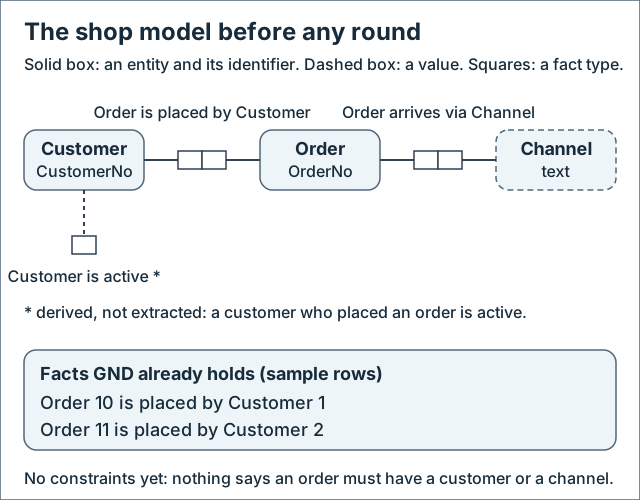
Source: growth/model.orm.yaml as shipped.
GND can read the model back as sentences. gnd extract writes a bundle whose
verbalization lists every fact type and the object type each role is played by:
gnd extract growth/model.orm.yaml --out start >/dev/null && sed -n '/=== Fact Types/,$p' start/model.verbalization.txt
=== Fact Types ===
Order is placed by Customer
  - order: Order (Integer)
  - customer: Customer (Integer)

Order arrives via Channel
  - order: Order (Integer)
  - channel: Channel (String)

Customer is active
  - customer: Customer (Integer)
Round 1: a returns note arrives
The first document is a note from the returns desk:
Returns desk note, week 44

Customers may send an order back within 30 days. A returned order comes
back through one of our channels, which need not be the channel it arrived
by. Order 10 arrived by courier and was returned in store; order 11 arrived
by post and was returned by post.
You type. With Claude Code and the gnd-model-evolve skill, the ask is a
plain sentence:
Use gnd-model-evolve on growth/model.orm.yaml with the additive policy. Read
growth/round-1.document.txt and propose only what it adds to the model. Preview
the round with the shape report and show me what GND says before you apply it.
Claude Code does. The skill writes a closed proposal that binds the current
model's digest and states the one addition: a fact type "Order is returned via
Channel", read from the note's second sentence. The shipped
growth/round-1.proposal.json is that proposal. Then it previews the round:
gnd evolve preview growth/model.orm.yaml growth/round-1.proposal.json --workspace growth --records growth/records --out growth/round-1.preview.json --policy additive --populated order_arrives_via_channel --shape-report
...
  breaking: false
  affected: fact_types[order_returned_via_channel]
  policy: additive
  populated: order_arrives_via_channel order_placed_by_customer
  shape-group: channel,order added order_returned_via_channel existing order_arrives_via_channel
You get. The model with one more fact type, drawn in green:
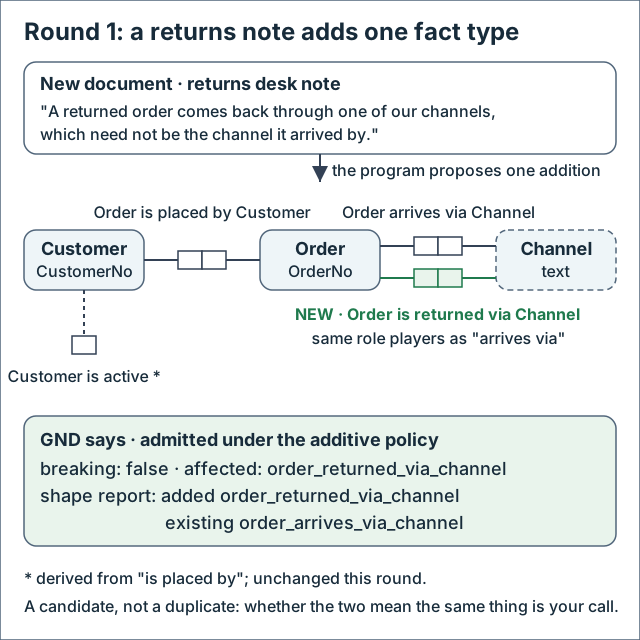
Source: growth/round-1.document.txt and the preview above.
GND says. Three things, in plain words:
- Admitted. The round only adds, so the additive policy lets it through.
breaking: falseand the only affected element is the new fact type. - These fact types hold facts. The
populated:line namesorder_placed_by_customer, because the model carries sample rows for it, andorder_arrives_via_channel, because the command said so with--populated. Facts your program extracted into its own population files are invisible to GND unless you name their fact types this way; the next round shows why that list matters. - Look at this one. The
shape-group:line says the neworder_returned_via_channelhas the same role players, Order and Channel, as the existingorder_arrives_via_channel. That is a candidate, not a duplicate: "returned via" and "arrives via" are different facts about the same two things. A program that proposes fact types from text will sometimes reinvent one it already has under new words, so GND points at every same-shape pair and leaves the decision to you. The report never changes the exit.
Apply the round, repeating the policy
apply must repeat --policy additive and the same --populated ids. It
refuses when the options differ from the preview's, and checks the policy
again on exactly what it publishes.
gnd evolve apply growth/model.orm.yaml growth/round-1.proposal.json --preview growth/round-1.preview.json --workspace growth --records growth/records --policy additive --populated order_arrives_via_channel
The grown model now reads back with four fact types:
gnd extract growth/model.orm.yaml --out after-1 >/dev/null && grep -v "^ -" after-1/model.verbalization.txt | sed -n '/=== Fact Types/,$p'
=== Fact Types ===
Order is placed by Customer

Order arrives via Channel

Customer is active

Order is returned via Channel
One thing to know about the published file: apply writes the proposal's
candidate model text exactly as the proposal carries it. These proposals were
built with the canonical candidate writer that gnd discover also uses, which
writes one-line JSON, so the comments and YAML layout of the original file are
gone. A proposal whose candidate text keeps them publishes them.
Round 2: an intake note arrives
The second document says something about orders the model already holds:
Order intake note, week 45

Every order must be placed by a customer. The shop no longer accepts
anonymous counter sales, so an order with no customer on it is a mistake.
You type. The same ask as before, for the new note:
Use gnd-model-evolve on growth/model.orm.yaml with the additive policy. Read
growth/round-2.document.txt and propose only what it adds. Preview the round
and show me what GND says before you apply it.
Claude Code does. The note reads like a rule, so the program proposes one:
a mandatory constraint on "Order is placed by Customer", saying every order
must have one. The shipped growth/round-2.proposal.json is that proposal,
bound to the model as round 1 published it. The preview:
gnd evolve preview growth/model.orm.yaml growth/round-2.proposal.json --workspace growth --records growth/records --out growth/round-2.preview.json --policy additive --populated order_arrives_via_channel 2>&1
EVOLUTION PREVIEW REFUSED (3): additive policy refused 1 operation(s); see policy_issues in <run>/growth/round-2.preview.json
...
  affected: fact_types[order_placed_by_customer].constraints[mandatory:new:0]
  policy: additive
  populated: order_arrives_via_channel order_placed_by_customer
  policy-issue: 0 constraint.populated.add fact_types[order_placed_by_customer].constraints[mandatory:new:0]
You get. Nothing new in the model. The proposed rule is drawn as an orange dot, and the model stays as round 1 left it:
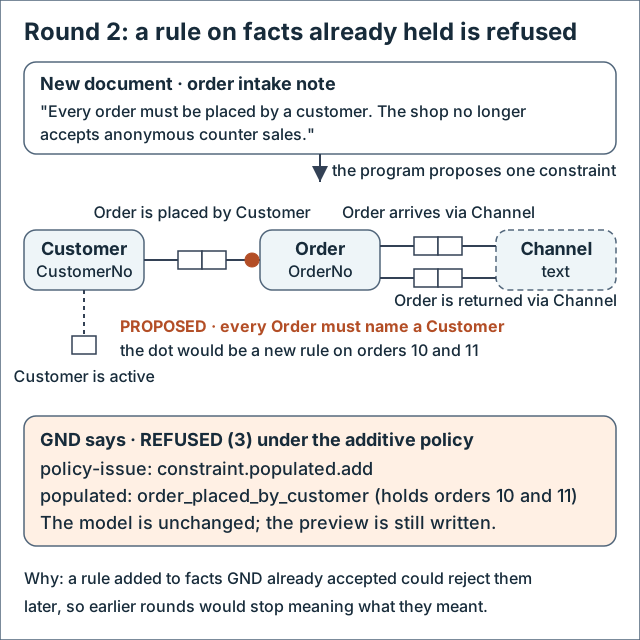
Source: growth/round-2.document.txt and the refused preview above.
GND says. Refused. The policy-issue: line names the operation
(the first and only one), the cell of the policy that refused it,
constraint.populated.add, and the constraint it would have added.
A constraint is not an addition in the sense the policy means. The two sample orders were accepted under a model that said nothing about customers being required; a rule added on top of them could reject them, or reject the next batch of facts extracted the same way, so every earlier round would mean something different from what it meant when it ran.
The populated: line is
the list the policy consulted, which is why naming extracted fact types with
--populated matters: a fact type GND does not know to be populated would
take the rule.
The preview file is still written, so the refusal can be read by a program as
well as a person; its policy_issues carry the same three fields. The full
policy is in the additive evolve policy reference.
A rule like this one is a job for a reviewed change with a person in the loop,
as in Expense chapter 3, not for the growing
program. There is one exception: when the facts the program extracted are in a
population file and every one of them satisfies the rule, --check-population
lets the policy admit the rule as a proposed, advisory constraint, relative to
that file (admitting a constraint on clean data).
Here the rule's fact type carries two sample rows in the current model, and the
population check never clears a rule over such a fact type, so round 2 stays
refused.
Give the extractor guidelines
With the model grown, the program's next job is to extract facts from the
documents into it. --guidelines adds a constraint-blind guide to the
extraction bundle: each fact type's reading, what each role means, and the
fact types that share role players. With Claude Code you would ask for the
gnd-extract skill:
Use gnd-extract with growth/model.orm.yaml and its guidelines. Extract the
facts in growth/round-1.document.txt and verify what you wrote.
The command behind it:
extracted bundle for growth/model.orm.yaml -> bundle
  model.projection.schema.json
  model.verbalization.txt
  model.applicable.json
  model.guidelines.md
  model.artifacts.json
The guide repeats the shape report's finding where the extractor will see it:
- Same role players as: `order_returned_via_channel`
- Same role players as: `order_arrives_via_channel`
The guide states no constraint (an external uniqueness that identifies an entity shows only as how that entity is identified), so the extractor writes what the document says, even where it breaks one. Round 1's note says order 10 arrived by courier and came back in store: two facts, one per fact type, and the guide's role descriptions tell the extractor which is which. A description is the modeller's prose and may restate a constraint; the guide repeats it as written.
Read the derivation rules back
Derivation rules your program wrote can be read back in GND's controlled language. The helper below prints each rule's fact type and its text. Constraints are not derivation rules and do not appear here:
python -c "from gnd import api; [print(r['fact_type'], '->', r['text']) for r in api.verbalize_rules('growth/model.orm.yaml')['rules']]"
customer_is_active -> when order_placed_by_customer(order = $o, customer = $c), derive (customer = $c)
See the rule verbalization reference.
When nobody reviews the model
If the model itself was proposed by an LLM with no person confirming it,
declare that with source.mode: unattended; gnd validate then requires
every element, sample row and constraint to cite its source text, except
common-sense constraints, which cite a library entry, and induced ones from
gnd discover, which cite the population they were found in. See the
gnd-model-from-text skill's Unattended mode.
A program that proposes only fact types stops at the skill's Steps 1 and 2: its
model fills with String value types and unrelated entity types, with no
uniqueness, mandatory or subtype rule. The skill's
unattended growth procedure
says what the program asks for at Steps 3 to 7, document by document, and when
to run a consolidation round over the whole model. One consequence for this
page's rounds: propose a fact type's constraints in the round that adds it, as
round 2 above shows a later one is refused. The procedure also says how a round
declares its new source document inside its proposal and checks every span with
gnd validate --document ... --require-documents.
Recap
| Round | The document said | The program proposed | GND said | The model |
|---|---|---|---|---|
| 1 | a returned order comes back through a channel | add "Order is returned via Channel" | admitted; same role players as "arrives via" | grew by one fact type |
| 2 | every order must be placed by a customer | a mandatory rule on "is placed by" | refused (3): constraint.populated.add |
unchanged |
Both rounds ran the same two commands with the same policy. The first grew the model and the second protected the facts it already held. Nothing was renamed, deleted or constrained behind the program's back.
Next steps
- The policy's every cell, and what
--populatedchanges, are in the additive evolve policy reference. - A change that is not additive, such as round 2's rule, goes through a reviewed proposal: Expense chapter 3 adds a required currency that way, and BookRec chapter 6 promotes an advisory rule to a hard one.
- The skills behind the asks on this page: change the rules safely
for
gnd-model-evolve, and the agent skill guide forgnd-extract. - Extracted facts are checked with
gnd verify; see evolution and recovery for the whole model-change workflow.